

©2026 ZenABM - All Rights Reserved.
Emilia Korczynska is Head of Marketing and co-founder at ZenABM. Before that she was VP of Marketing at Userpilot for nearly 7 years, where she ran a large ABM program primarily on LinkedIn ads.

The best 6sense alternative depends on which part of 6sense you would actually use. It is an enterprise suite built for display advertising at scale, and for LinkedIn ads it is overkill.
If you run ABM mostly on LinkedIn, ZenABM shows which companies engage with your ads, straight from the official LinkedIn Ads API and with no form fills needed. It scores them and ties them to pipeline.
The 8 tools below cover every other slice of 6sense, picked from a much bigger field of ABM tools.
Here is the whole post in one picture.

Here are all 8 side by side: what each one replaces from 6sense, what it costs to start and how reviewers rate it.
Tool | Best for | What it replaces from 6sense | Starting price | G2 rating |
|---|---|---|---|---|
ZenABM | LinkedIn-first ABM without an enterprise budget | LinkedIn campaigns, account engagement, stages, attribution | From $59/month (billed annually) | 5/5 from 6 reviews |
Demandbase One | Like-for-like enterprise suite, display at scale | Display DSP, account intelligence | No public price; Vendr median $68,591/year | 4.4/5 from 2,012 reviews |
Dreamdata | Multi-channel revenue attribution | Revenue attribution | Free Starter; Vendr median $35,440/year | 4.7/5 from 271 reviews |
Factors.ai | Account journey analytics | Visitor ID, attribution | Free plan; paid plans not published (Vendr median $19,200/year) | 4.5/5 from 220 reviews |
HubSpot Marketing Hub | Teams already on HubSpot CRM | Attribution, workflows | Professional $800/month, Enterprise $3,600/month | 4.4/5 from about 16,001 reviews |
DemandSense | AI prioritisation and LinkedIn control on a small budget | Account intelligence | $89/month (Base), $149/month (Plus) | 5.0/5 from 14 reviews |
Recotap | Account-based retargeting and personalisation | Retargeting, personalisation | $1,499/month (Standard, billed annually) | 4.7/5 from 57 reviews |
N.Rich | Programmatic ABM engine on a mid-five-figure budget | B2B DSP, intent | $34,830/year (Growth) | 4.7/5 from 115 reviews |
Here is a quick way to pick by situation:
Your situation | Best pick | Why |
|---|---|---|
LinkedIn is your main paid channel and 6sense is overkill | ZenABM | Creates and manages LinkedIn campaigns and shows company engagement from $59/month |
LinkedIn campaign optimisation | ZenABM, then Linklo or DemandSense | Budget Savers, exclusions and the Bidding agent act on live campaigns |
Display advertising at very large scale | Demandbase One | Native B2B DSP across display, native, video and CTV |
Revenue attribution across channels | Dreamdata or Factors.ai | Multi-touch attribution and account journeys |
You already run HubSpot CRM | HubSpot Marketing Hub, with ZenABM for LinkedIn data | Native workflows; ZenABM writes LinkedIn engagement onto HubSpot companies |
Small budget, want AI prioritisation | DemandSense | $89 to $149/month with scheduling and frequency control |
Retarget warm accounts | Recotap | Personalised ads and 1:1 landing pages |
Programmatic ABM with intent | N.Rich | Own DSP and Dynamic ICP Builder |
Terminus, Madison Logic, Linklo, LinkedScope and Satlo are in the 6sense competitors section.
See which companies engage with your LinkedIn ads
ZenABM shows the companies behind your LinkedIn ad engagement and scores them, without an enterprise contract.

6sense is a legacy enterprise suite. Most people I've spoken to who used it never saw the ROI on the very high investment it took to buy it. It is hard to implement, and many teams never use it to its full capacity. For LinkedIn ads it is complete overkill, which is why so many people look for alternatives.
To be fair, it has real upsides. Its display ad network is robust, and its revenue attribution features are sound (so we've heard).
6sense scores accounts from 0 to 100 and maps them to five buying stages (Target, Awareness, Consideration, Decision, Purchase). It buys display, native, video and CTV through its own B2B ad platform, identifies website visitors through its Company Graph, and adds RevvyAI and an MCP server in 2026. I had a few demos with them and decided against it, because it was too complex and too expensive for what we needed.
Here is what pushes teams out:
6sense is rated 4.2/5 on G2 from 1,580 reviews, and reviewers praise the visibility into account buying journeys. It has 4.4/5 on Gartner Peer Insights, 8.4/10 on TrustRadius and 4.5/5 on Capterra.

6sense's own campaign type screen shows the display and LinkedIn options you pay for.

6sense runs LinkedIn in two ways: it either creates and bills a LinkedIn ad account for you, or it syncs dynamic segments to Campaign Manager audiences daily. Segments need about 300 matching LinkedIn member profiles, and only Brand Awareness and Consideration objectives are supported. 6sense also adds a 15% Ad Services Fee on top of LinkedIn spend. Its company attribution is click-based, so view-through influence is undercounted, and job function and seniority targeting is added inside Campaign Manager, not from 6sense's own persona data.
A LinkedIn-first stack does the same job differently. You target companies and job titles from LinkedIn's self-reported data. ZenABM matches impressions, clicks and engagements to the company behind them through the LinkedIn Ads API, applies exclusions team-wide and keeps LinkedIn Audience Network and Audience Expansion off, with no markup on your ad spend. That is the LinkedIn-first way to run ABM.

Once you know which part you are replacing, compare the candidates on these criteria. I used them for the account intelligence and attribution tools below:
Here is what I would do when evaluating 6sense or any enterprise suite:

ZenABM was designed specifically for running ABM campaigns on LinkedIn. It helps small to mid-market companies, enterprise teams and agencies create, manage and optimize their LinkedIn ads with AI, in the app or directly from Claude through the MCP server. It shows account engagement at company level, extracts first-party intent signals and scores accounts automatically. It also gives you revenue attribution plus the sales-ready hot accounts. When I was VP of Marketing at Userpilot, I struggled to run ABM on LinkedIn. My husband watched it up close and built ZenABM to fix it. I might be a bit biased as a co-founder, but I also know first-hand what it is like to struggle to find the right tool.
G2 rating: 5/5 from 6 reviews. One reviewer wrote that "what I like best about ZenABM is that they understand ABM beyond theory". A VP of Marketing said ZenABM "allows me to quickly query my LinkedIn ad performance data with AI".

Here is how ZenABM compares with 6sense on the features a 6sense leaver cares about:
Capability | 6sense | ZenABM |
|---|---|---|
Company engagement | Account metrics for campaigns run through 6sense, click-based | Impressions, clicks and engagements matched to the company, with score, stage, intents and CRM data on one row |
Intent | Third-party (6sense network, G2, TrustRadius, Bombora) | First-party theme intent from engagement with your own ads |
Account stages | Predefined buying stages from a predictive model | Stages you define as rules over LinkedIn engagement and CRM conditions |
Job title engagement | Persona maps by job level and function | Engagement grouped by job title |
Campaign management | RevvyAI builds audiences and launches campaigns | Zena builds campaigns, ad sets, targeting and ads from chat; Budget Savers, exclusions, Bidding agent |
MCP | Read-only retrieval | 93 tools (69 read, 24 write): create and manage campaigns from Claude |
Deal attribution | Account activity timelines | Impressions, clicks, engagements and spend behind every deal |
CRM sync | Salesforce, HubSpot, Marketo | HubSpot, Salesforce, Attio, plus webhooks to Clay, n8n and Slack |
ZenABM's Company engagements view shows every company engaging with your ads, with its engagement score, ABM stage and CRM data on one row, which Campaign Manager does not expose.

ZenABM turns engagement with themed ads into intent signals per account. It syncs them to your CRM. You see what each account is interested in from your own ads. 6sense has no first-party LinkedIn ad engagement as an intent source.
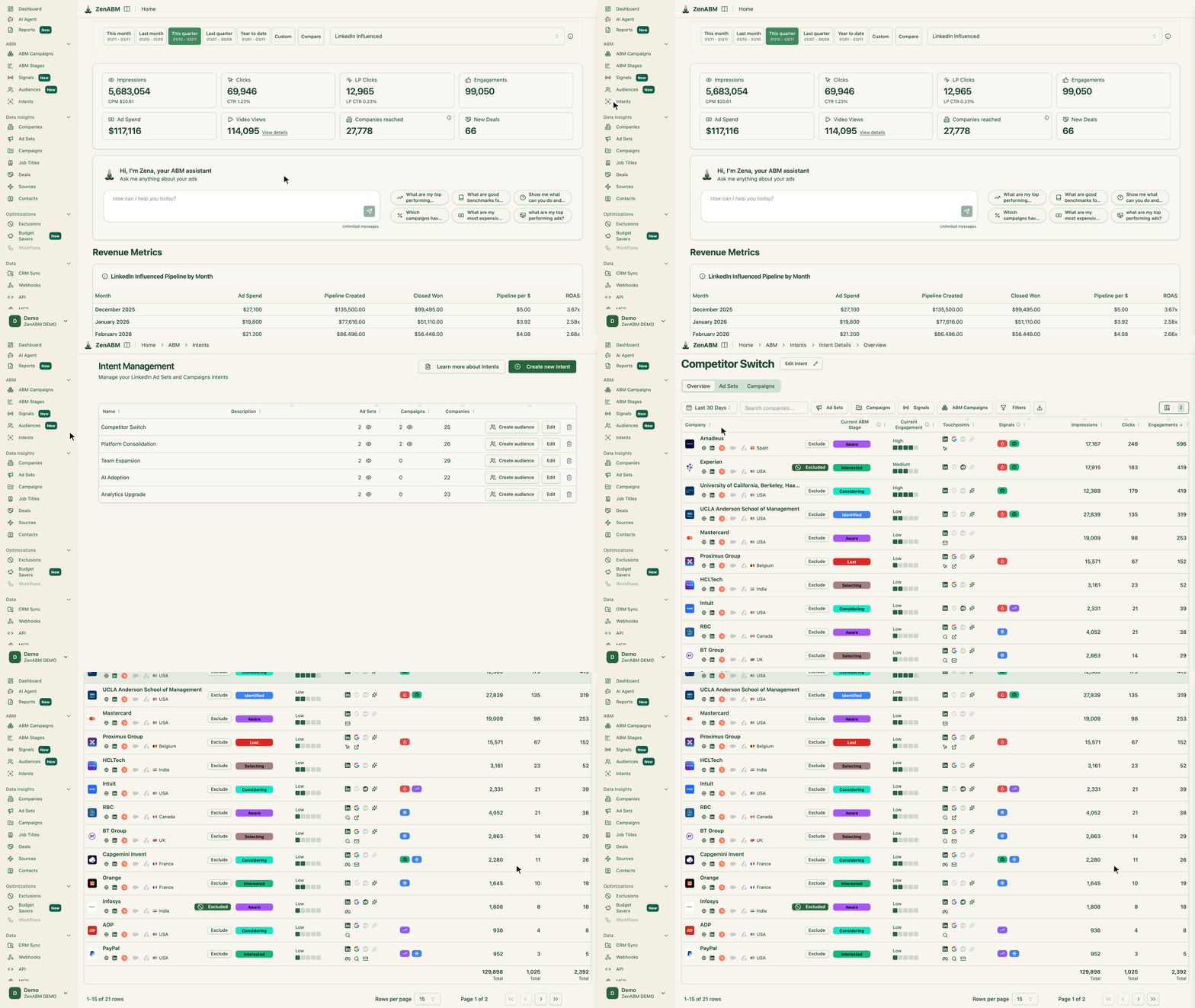
ZenABM moves every account through the ABM stages you define, based on ad engagement and CRM data. One fractional demand gen lead on a sales call described this as white box versus 6sense's black box.

ZenABM's deal attribution shows the ad touchpoints behind every deal, both before it opened and before it closed.
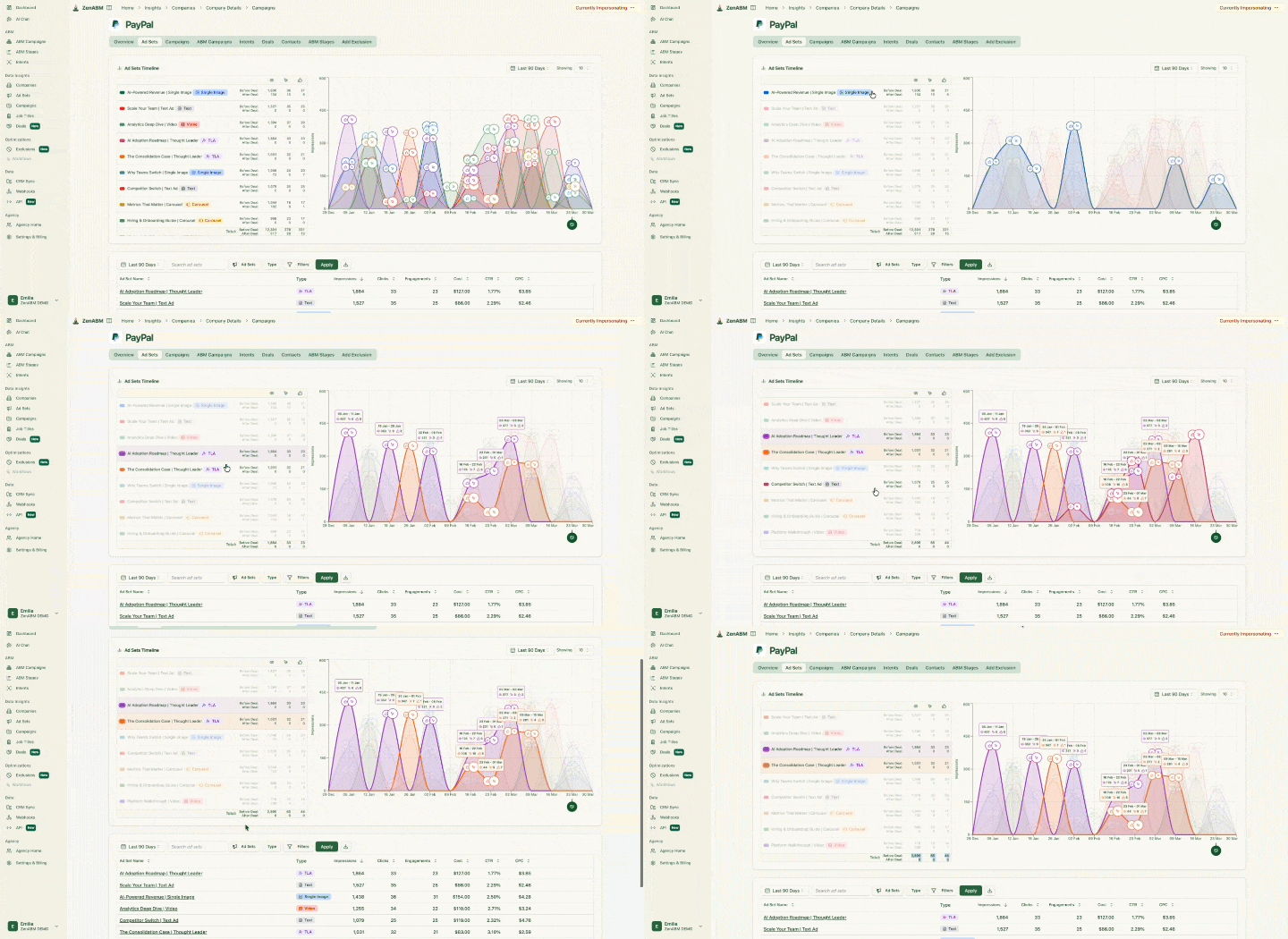
Zena, ZenABM's AI agent, answers questions about your live LinkedIn ads data in plain language, so you do not export CSVs to find out what is working.

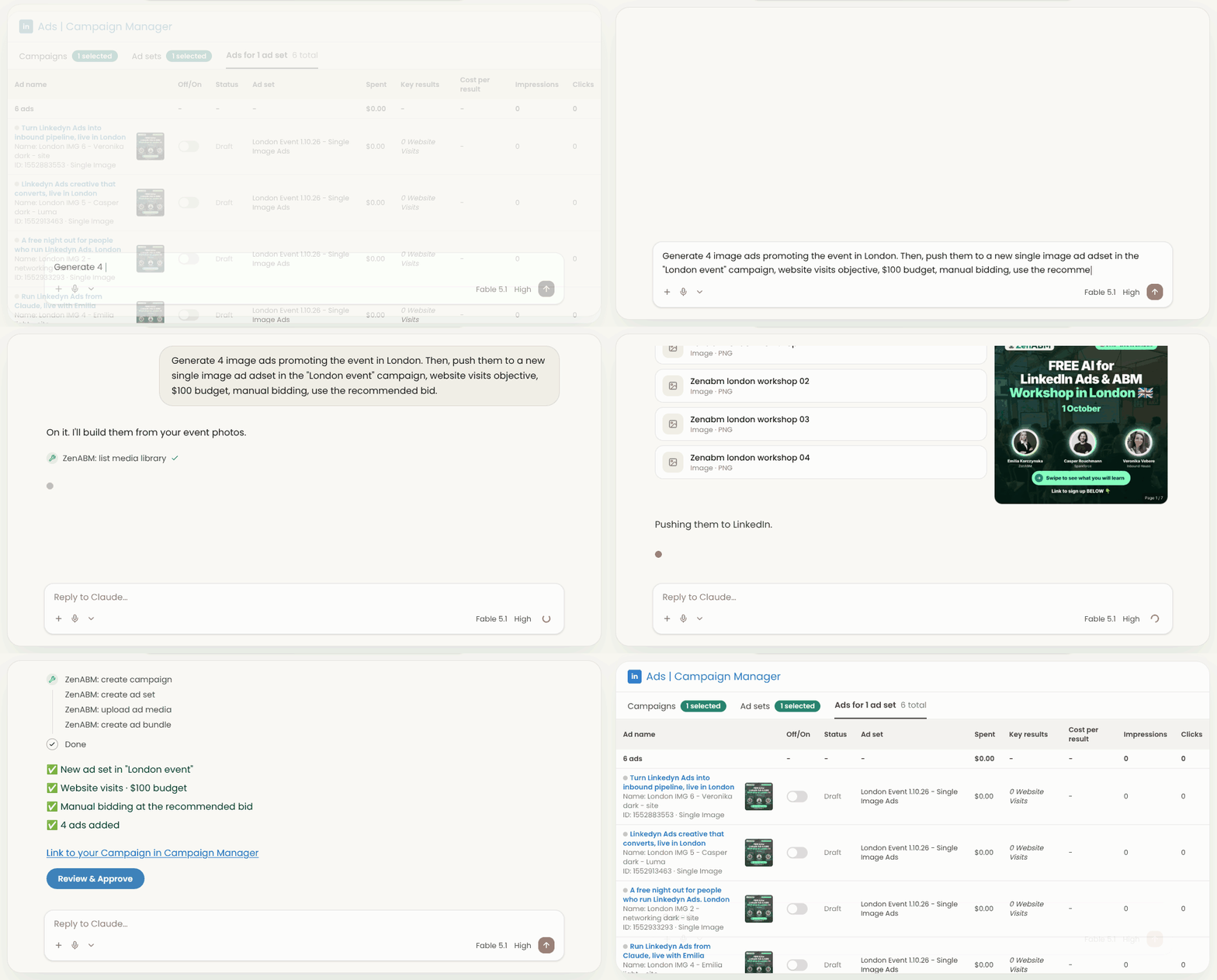
ZenABM's MCP server connects your LinkedIn ads to Claude, ChatGPT or Cursor. It writes as well as reads. You can create and manage campaigns, ad sets and ads straight from Claude. 6sense's MCP is read-only.
ZenABM's Budget Savers keeps LinkedIn Audience Network and Audience Expansion switched off on every ad set, including ones created later, and exclusions apply across all campaigns, including new ones.

ZenABM runs from Starter at $59/month to Agency at $479/month, billed annually, with no markup on LinkedIn ad spend. The median 6sense buyer pays $62,220 a year.
ZenABM is LinkedIn-first, so it does not buy display or programmatic ads, personalise websites or sell third-party intent data. Teams that need those usually run ZenABM for LinkedIn next to a display suite. Reviewers raise a few mild points: ABM results take time to compound, one would like a Pipedrive integration, company data sometimes loads slowly, and some LinkedIn-side restrictions are annoying. The team ships new features fast and keeps improving the product based on customer feedback.
If LinkedIn is where your ABM budget goes, ZenABM gives you engagement, intent, stages and pipeline attribution without an enterprise contract. If display advertising is your main channel, pair it with a display suite.
Demandbase One is an enterprise account-based suite built around its own B2B ad platform across display, retargeting, native, video and CTV, plus LinkedIn, Meta and Google. I had a couple of demos with their team, and display advertising at very large scale, which suits B2C companies especially, is where it is strongest. It has been on the market the longest, so it is often the default choice. AdRoll ABM (formerly RollWorks) sits in the same group and is the easier option. I evaluated AdRoll for my ABM programme at Userpilot in 2024 and had several demos with the team.
G2 rating: 4.4/5 from 2,012 reviews. Reviewers cite a steep learning curve (86 mentions) and reporting and customisation complexity (63 mentions).

Demandbase's Inventory Planner is where you configure the ad inventory you buy.

Best for: enterprises running display at very large scale. Skip it if you run mostly LinkedIn ads on a small team.
Compared with ZenABM: Demandbase is display-first and weaker for running ABM on LinkedIn, where ZenABM creates and manages the campaigns.
Dreamdata is the most complete attribution tool of its group, but it is not geared towards managing and running ABM campaigns on LinkedIn. I had a demo with them, and the depth is in attribution, not in campaign control.
G2 rating: 4.7/5 from 271 reviews. Reviewers praise clear customer journeys and multi-touch attribution, and complain about a steep learning curve.

The next screenshot shows Dreamdata's revenue analytics dashboard overview.

Best for: teams with a RevOps or data resource that want attribution across many channels.
Compared with ZenABM: ZenABM creates and manages the LinkedIn campaigns and costs far less, while Dreamdata covers more channels.
Factors.ai is a multi-channel analytics platform. Its strength is data depth: its Company Intelligence API, announced on 19 November 2025, includes organic LinkedIn page engagement. It leans towards analytics and takes more effort to set up and use than ZenABM, and it is less focused on running ABM campaigns.
G2 rating: 4.5/5 from 220 reviews. Reviewers praise real-time insights and the interface, and mention a learning curve and slow segments on larger datasets.

The next screenshot shows the Factors.ai AdPilot accounts dashboard with engagement metrics.

Best for: growth teams that want journey analytics more than campaign control.
Compared with ZenABM: ZenABM is cheaper, lets you create and manage the LinkedIn campaigns, is built for ABM and is easier to use.
HubSpot Marketing Hub goes in the opposite direction from an enterprise suite: it is one platform on the CRM your sales team already uses. This is the best 6sense alternative for HubSpot users who want things native.
G2 rating: 4.4/5 from about 16,001 reviews. Reviewers cite a learning curve (808 mentions), advanced features gated to higher plans (785) and pricing that rises with contacts (666).

Here is how HubSpot's attribution models compare.
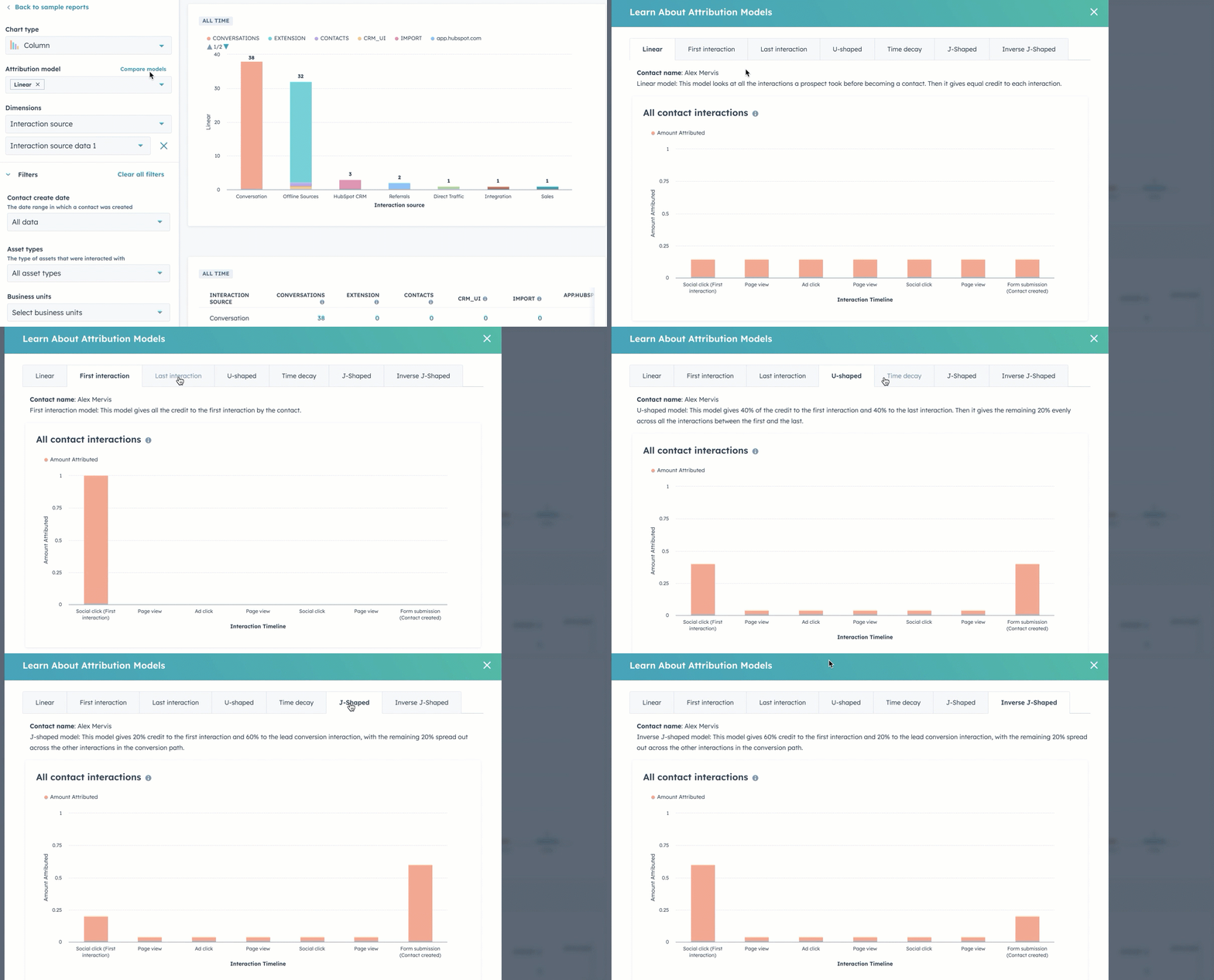
Compared with ZenABM: ZenABM writes LinkedIn engagement, scores, stages and intent onto HubSpot company records, which HubSpot's own LinkedIn link does not.
DemandSense combines LinkedIn ads control (hour-level scheduling, frequency caps, audience tuning) with visitor identification and attribution.
G2 rating: 5.0/5 from 14 reviews. Reviewers praise attribution beyond Campaign Manager and anonymous visitor identification, and mention setup time and a still-maturing AI Co-Pilot.

The next screenshot shows the DemandSense LinkedIn ad campaign scheduling interface.

Compared with ZenABM: ZenABM has no credits and flat pricing, creates and manages campaigns and uses first-party engagement, while DemandSense wins on site-visitor ID and hour-level scheduling.
Recotap orchestrates personalised LinkedIn and display ads and 1:1 landing pages against your own LinkedIn ad account, with Bombora and G2 intent.
G2 rating: 4.7/5 from 57 reviews. G2 scores ease of setup 9.5 against 7.5 for 6sense, and reviewers mention no native media attribution and a steeper learning curve.

The next screenshot shows an ABM account intelligence dashboard with an engagement timeline.

Compared with ZenABM: Recotap is personalisation-first, while ZenABM is analytics-first LinkedIn ABM and costs far less.
N.Rich runs its own B2B ad platform for programmatic display, native and video, with a Dynamic ICP Builder, first and third-party intent and opportunity attribution.
G2 rating: 4.7/5 from 115 reviews. Gartner Peer Insights has it at 4.6/5 from 26 reviews. Users praise intent quality and responsive support, and mention integration gaps and limited reporting.

The next screenshot shows the N.Rich opportunity attribution dashboard.

Compared with ZenABM: ZenABM stays on LinkedIn and costs a fraction, while N.Rich adds programmatic reach.
These five are not in the top 8, but each replaces a different slice of 6sense.
Terminus is now part of DemandScience, which absorbed it in a merger on 12 November 2024, and terminus.com redirects there. It is an ABM engagement hub for multi-channel ads, web personalisation and attribution. On G2 it is rated 4.4/5 from 121 reviews. Pricing is not published, and Vendr's median is $24,840 a year. Reviewers cite a clunky interface and a weak HubSpot integration. It is best for teams that want one ad and orchestration hub. Compared with ZenABM, ZenABM is built for LinkedIn and far cheaper.

Madison Logic combines content syndication, display, LinkedIn, CTV and audio. On G2 it is rated 4.3/5 from 275 reviews. Pricing is not published. Reviewers cite a steep learning curve, and it has no native visitor identification, which is why many teams look for Madison Logic alternatives. It is best for multi-channel scale led by syndication.

Linklo is a LinkedIn Ads layer for scheduling, budget control, A/B testing and Company Flows, and it also writes LinkedIn exposure fields into HubSpot company records. Core is $99 per month with a 21-day free trial. It is best for dayparting and delivery control.

LinkedScope shows which companies saw and engaged with your LinkedIn ads and matches them to CRM deals (HubSpot, Salesforce, Pipedrive, Dynamics 365). There is a 15-day free trial with month-to-month billing. It is best for lightweight LinkedIn company reporting.

Satlo gives company-level LinkedIn ad visibility with unlimited history and exports. G2 shows 5/5 from 1 review. It is best for small teams that need lightweight company reporting.

ZenABM is the pick, with Linklo or DemandSense as runner-ups if you also want scheduling control. ZenABM runs the whole LinkedIn motion, from campaigns to pipeline.
ZenABM is the pick here too: Budget Savers, exclusions and the Bidding agent act on live campaigns, and the Bidding agent flags ads whose click-through rate is sliding. Linklo and DemandSense are runner-ups for scheduling and frequency.
Dreamdata or Factors.ai work best across channels. If you only need LinkedIn deal attribution, ZenABM shows the touchpoints behind each deal.
HubSpot Marketing Hub fits if you want it native and have Enterprise. ZenABM fits if you want LinkedIn engagement, scores and stages written onto HubSpot company records, and Dreamdata covers attribution.
ZenABM from $59/month or DemandSense from $89/month, against a five-figure yearly bill for 6sense.
Demandbase One is the choice, or AdRoll ABM if you want something easier.
Stay if you run display at very large scale across thousands of target accounts and have the ops team to run it. 6sense's display network and attribution are its sound strengths. It also added RevvyAI and an MCP server in 2026. Katya Tarapovskaia, who runs an AI ABM agency in partnership with 6sense and HubSpot, uses ZenABM to add signals next to Clay, Apollo and 6sense, so the two can coexist. If you switch, run the new tool alongside 6sense for the last 60 days of the contract.

Track company engagement and pipeline from your LinkedIn ads
Start with LinkedIn engagement and CRM sync from $59/month, then add tools only where you hit a gap.
Pick the tool for the job you need done, not the longest feature list. Otherwise you pay for the whole gym and use the treadmill 🤷♀️
For a lean stack, pair ZenABM with Dreamdata for cross-channel ROI, with HubSpot to push intent and scores into workflows, or with Clay by webhooking hot accounts for auto-prospecting.

If you want the benchmark context behind LinkedIn spend, get the 2026 ABM Benchmarks Report.
It depends on which part of 6sense you use. ZenABM is the best 6sense alternative for LinkedIn-first ABM, a LinkedIn-first tool from $59/month. Demandbase One suits display at scale, Dreamdata or Factors.ai suit attribution, and HubSpot Marketing Hub suits teams already on HubSpot.
6sense's main competitors are Demandbase, AdRoll ABM, DemandScience (formerly Terminus), Madison Logic and N.Rich for enterprise suites and programmatic. ZenABM competes on LinkedIn-first ABM, and Dreamdata and Factors.ai compete on attribution. Each one replaces a different slice of what 6sense does.
6sense has no public price. Vendr's median is $62,220 a year (range $11,191 to $175,915, 388 purchases), and a Reddit buyer reported a $120,000 first-year quote. There is no trial, and LinkedIn spend through 6sense carries a 15% fee. ZenABM starts at $59/month.
HubSpot Marketing Hub is the native option, but deal and revenue attribution needs the Enterprise tier at $3,600 per month. ZenABM writes LinkedIn engagement, scores, stages and intent onto HubSpot company records from $59/month.
6sense either creates and bills a LinkedIn ad account for you or syncs dynamic segments to Campaign Manager audiences daily. Segments need about 300 matching profiles, only Brand Awareness and Consideration objectives work, and there is a 15% Ad Services Fee. Attribution is click-based.
Most teams do not need a one-to-one replacement. They need outcomes: find hot accounts, understand intent, activate sales and prove pipeline. A lean stack such as ZenABM plus Dreamdata or HubSpot covers that, at the cost of managing a few integrations.
About the author

